What Happens at a Dog Grooming Appointment: A Step-by-Step Guide
What Happens at a Dog Grooming Appointment: A Step-by-Step Guide
Most dog owners drop off their dog, come back two hours later, and receive a cleaner, tidier version of the animal they left. What happened in between is largely a mystery. For anxious owners, that mystery can be stressful. For owners who want to be good advocates for their dogs, it's useful to know what a professional grooming appointment actually involves.
Different breeds need different things at each stage, and every dog brings their own temperament to the table — sometimes literally. But the core process of a professional full-service groom follows a consistent sequence, and understanding it helps owners communicate better, ask better questions, and recognize the difference between a groomer who takes the work seriously and one who doesn't.
Before the Appointment: The Check-In
A professional grooming check-in is more than handing over the leash. A thorough groomer will ask a set of questions before they take your dog:
- What services are you looking for today? Full bath and haircut, bath only, deshedding treatment, nail trim only, etc.
- Any changes since last visit? New medications, health issues, changes in temperament or behavior?
- How has their coat been? Any areas of matting you've noticed, changes in coat texture, recent skin issues?
- Are there any sensitive areas? Dogs who've developed arthritis may resist having their rear legs handled. Dogs with past ear infections may be ear-sensitive. This is important information.
- Any behavioral notes? Does your dog have a history of snapping, muzzle use, or particular stress triggers?
For first visits, the check-in is longer and more detailed. For returning clients, it's a quick update on anything that's changed.
What you should bring to the check-in:
- Your preferred cut style (a photo on your phone is ideal)
- Any information about your dog's health that's relevant
- Your contact number so the groomer can reach you during the appointment if needed
Step 1: Pre-Bath Assessment
Before the dog goes anywhere near the tub, an experienced groomer conducts a quick assessment of the dog's coat and overall condition. This takes 2–5 minutes and includes:
Coat check: Is there matting? If so, how significant is it and where is it located? A groomer who discovers significant matting should call you before proceeding — the decision about how to handle matting (try to brush out, or opt for a shorter cut) should involve the owner.
Skin check: Any visible skin issues, hot spots, lumps, or unusual areas? Groomers are often the first people to notice skin abnormalities because we're handling the coat systematically rather than incidentally.
Overall health assessment: Is the dog moving normally? Any signs of pain or discomfort? Does anything seem off that the owner should be aware of?
Nail and ear check: How long are the nails? Is there any obvious ear issue (odor, dark discharge) that should be noted?
This assessment shapes the plan for the rest of the appointment and gives the groomer a chance to flag any concerns before starting.
Step 2: Pre-Bath Brush-Out
For most dogs — and especially for any dog with medium to long hair, double coats, or continuously growing coats — the appointment begins with a brush-out before the bath. There's a specific reason for this order.
Water tightens tangles. Any loose knot or beginning mat that's present when the dog goes into the tub becomes significantly tighter when wet. Removing as much loose coat and working through tangles before bathing makes the bath and drying process more efficient and produces a much better result.
For dogs with significant undercoat (Labradors, German Shepherds, Golden Retrievers), the pre-bath brush-out also removes loose fur that would otherwise clog the drain and make rinsing less thorough.
For dogs with severe matting, the pre-bath assessment may determine that the mats are too significant to brush out and the dog should go straight into the tub before any cutting decisions are made. An experienced groomer can feel the difference between a mat that will respond to patient work and one that requires a different approach.
Step 3: The Bath
The bathing process for a professional groomer is more systematic than a home bath:
Water temperature: The water should be comfortably warm — warmer than most owners would use, but not hot. Dogs have a higher resting body temperature than humans (101–102.5°F is normal), but they're still sensitive to water that's too hot.
Wetting the coat: For double-coated or densely-furred breeds, getting the coat thoroughly wet takes time. A groomer will work water into the coat by hand, ensuring it penetrates the undercoat rather than just sitting on the surface.
Shampoo selection: Professional groomers select shampoo based on coat type and any specific concerns — a moisturizing formula for dry coats, a deshedding formula for heavy-shedding breeds during coat blows, a medicated or soothing formula for dogs with skin sensitivities. The days of one-shampoo-fits-all are behind most professional groomers.
The scrub: Shampoo is worked into the coat from skin to tips, with particular attention to areas that collect dirt and oil — the paws, the belly, the area under the tail, and the face. A groomer doing their job properly is feeling the coat down to the skin throughout, not just creating suds on the surface.
Conditioner: Most professional groomers use a conditioner after shampooing, particularly for medium to long coats, curly coats, and dogs with dry or coarse hair. Conditioner reduces static, eases brushing, and protects the coat. Some groomers use a detangling conditioner left in while finishing the bath; others rinse fully.
Final rinse: Shampoo and conditioner residue left in the coat causes skin irritation and coat dullness. The rinse is thorough — particularly through the undercoat on double-coated breeds.
Step 4: Drying
Drying is one of the most underappreciated and technique-dependent parts of the grooming process — and the step where the most things can go wrong with inadequate training.
Towel drying: Immediately after the bath, most groomers towel dry first — absorbing as much surface water as possible before introducing dryer heat. This reduces total drying time and heat exposure.
High-velocity (force) drying: Most professional salons use a high-velocity dryer — a powerful airflow device that moves water out of the coat rather than evaporating it with heat. High-velocity dryers have no or very low heat; the water removal is entirely mechanical. For double-coated breeds, this step simultaneously removes enormous quantities of loose undercoat — it's the most effective deshedding technique available.
Stand or hand dryer: For finishing — particularly on small dogs, curly coats, or when styling a specific look — groomers use a stand or hand dryer with warm air while brushing through the coat simultaneously. This technique straightens curly coats, sets double coats flat, and gives the finished coat its clean, polished appearance.
Why thorough drying matters: A coat that's damp at the skin when the dog leaves the salon is a condition for hot spots (in double-coated breeds), skin fold infections (in dogs with skin folds), and general discomfort. A properly dried dog shouldn't have any moisture at the skin level when they leave.
Step 5: Post-Dry Brush-Out
After the coat is fully dry, the groomer does a second thorough brush-out. This step is essential for quality results and is often where less thorough groomers cut corners.
Drying and the high-velocity blow-out shifts the coat significantly, brings up remaining loose undercoat that wasn't ready to release during the pre-bath brush, and can reveal tangles that weren't apparent in the wet coat. The post-dry brush-out resolves all of this and prepares the coat for trimming.
A dog whose coat hasn't been properly brushed out after drying will have an uneven, bumpy cut — the shears or clippers can't glide through a coat that has remaining tangles.
Step 6: Nail Trim
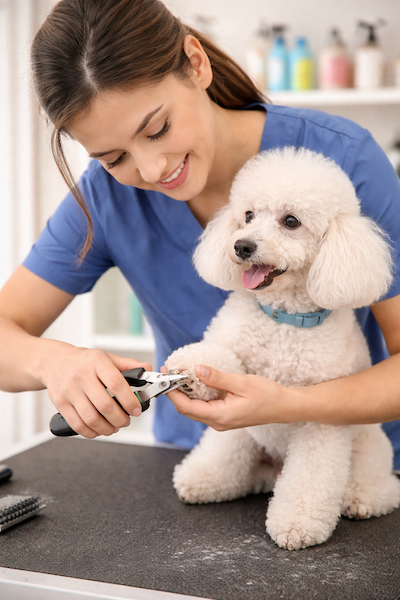
Nail trimming is included in most full-service grooms. The groomer trims each nail, typically with a clipper followed by a grinder to smooth the edge. The nail should be trimmed to just short of the quick (the blood vessel inside the nail) — finding the right length requires skill, particularly on dogs with dark nails where the quick isn't visible from the outside.
Most groomers will file or grind nails after clipping to smooth sharp edges. A nail that's been clipped but not smoothed can catch on fabrics and cause discomfort.
Nail trimming is the step dogs are most commonly sensitive about. Paw handling during puppyhood (see our guide to first grooming appointments) makes a significant difference in how cooperative a dog is for nails throughout their life.
Step 7: Ear Cleaning
Basic ear cleaning — removing visible wax and debris from the outer ear canal — is typically included in a full-service groom. The groomer uses an ear cleaning solution and cotton pads to clean the visible portion of the ear, working only where they can clearly see.
Groomers do not probe into the ear canal. Anything beyond the visible outer ear requires veterinary instruments and training. If a groomer notices redness, unusual discharge, strong odor, or signs of infection during the ear cleaning, they should flag it to the owner — this is information for your veterinarian.
For breeds with hair growth in the ear canal (Poodles, Bichons, some Doodles), the groomer may also remove ear canal hair. Whether to do this routinely is a subject of genuine debate among groomers and veterinarians; discuss with your groomer and your vet what's appropriate for your specific dog.
Step 8: The Haircut (For Breeds That Need One)
For dogs who require a trim or full cut — Poodles, Schnauzers, Shih Tzus, Doodles, Yorkies, Cocker Spaniels, and many others — the cutting portion happens after the bath and brush-out. Cutting a dirty, unbrushed coat produces poor results and is harder on the tools.
The cut is executed with a combination of clippers (for body coat and close-cut areas) and scissors (for detail work, shaping, and blending). Skilled groomers use scissors extensively — clipper-only cuts often look choppy and lack the blended, polished finish of scissor finish work.
The specific cut depends on the discussion at check-in. A good groomer follows the instructions given, asks for clarification if there's ambiguity, and calls if they encounter a situation (matting, coat condition) that changes what's achievable.
Step 9: Final Touches
After cutting, most groomers do a final finishing pass:
- Spritz or cologne: A light application of pet-safe fragrance (entirely optional and should be skipped for sensitive dogs)
- Bandana or bow: Many salons add a finishing touch; some dogs love it, some tolerate it, some it's skipped for
- Final inspection: The groomer checks their work — even lengths, clean lines, symmetry, no missed patches
Step 10: Pickup and Debrief
At pickup, a professional groomer should give you a brief report on how your dog did — what went well, any areas of sensitivity they noticed, any physical findings (a lump, a skin area, an ear concern) that you should be aware of.
If the groomer completed a different cut than expected — shorter because of matting, for example — they should explain what they found and what they did, not hand you back the dog and hope you don't notice.
This debrief is valuable information. Listen to it. A groomer who communicates honestly about what they found and what they did is a groomer you want to keep.
Finding a Groomer Who Does It Right
Understanding the full process makes it easier to evaluate a groomer — you know what questions to ask, what to look for when you visit a salon, and what a thorough versus a rushed appointment looks like. Use Dog Groomer Locator to find groomers in your area with verified credentials and detailed service listings, and don't hesitate to ask your prospective groomer to walk you through their specific process for your dog's breed and coat type.
If your dog has health-related concerns — skin conditions, ear infections, or anxiety — that are regularly surfacing at grooming appointments, it may be worth pairing your grooming care with a veterinary conversation. Holistic Vet Directory can connect you with integrative veterinarians who look at the whole picture when recurring issues need a deeper investigation.
A professional grooming appointment is more than a bath and a haircut. Done properly, it's a systematic health check, a coat management service, and a welfare interaction with a trained professional who knows dogs. Understanding what happens during those two hours helps you be a better advocate for your dog — and helps you recognize the difference between a groomer who's truly skilled and one who's just going through the motions.
About the Author
Dog Groomer Locator Editorial Team
Our editorial team researches grooming topics using verified business data and breed-care references. Content is drafted with AI assistance, fact-checked against published sources, and reviewed by publisher Kevin Collins.