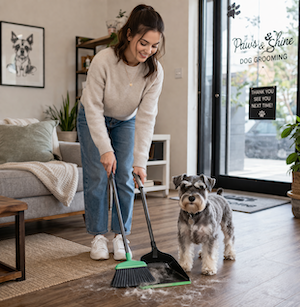
Spring Dog Grooming: How to Survive Shedding Season Without Losing Your Mind
Spring Dog Grooming: How to Survive Shedding Season Without Losing Your Mind
If you've ever owned a double-coated dog, you know the feeling. You vacuumed yesterday. You brushed the dog this morning. You're wearing a black sweater, the dog looked at you from across the room, and somehow you're already covered in hair. Welcome to spring shedding season — also known in the grooming world as the "coat blow."
Spring shedding is not just a slight uptick in normal hair loss. It's your dog's entire dense winter undercoat releasing over the course of a few weeks. For breeds like Huskies, Golden Retrievers, German Shepherds, Bernese Mountain Dogs, Corgis, Chow Chows, and Samoyeds, the volume of hair involved can be genuinely staggering. A late-March de-shed appointment can remove enough coat from a single dog to stuff a small pillow.
This guide is the honest, practical version of "here's how to survive it" — the tools that actually work, the things that don't, and what a professional de-shed can accomplish that home brushing simply can't.
Why the Spring Coat Blow Happens
Double-coated dogs have two distinct layers of fur: a soft, dense undercoat that insulates against cold, and a topcoat (guard hairs) that protects against UV, water, and dirt. The undercoat is seasonal — the body grows more of it going into winter and sheds it out in spring as temperatures rise and days lengthen.
The trigger for shedding is primarily photoperiod (day length), not temperature — which is why dogs shed even in climate-controlled homes and why dogs in southern climates still go through a spring blow. The changing light tells the body it's time, and the coat responds accordingly.
In a healthy dog, the dead undercoat releases in waves over three to six weeks. In a dog who isn't being brushed regularly, it doesn't disappear — it accumulates. The shed coat packs against the skin, trapping moisture and heat, and can eventually form mats if left long enough.
The Breeds Most Affected
Not every dog goes through a significant spring shed. Single-coated breeds (Poodles, Maltese, Shih Tzus, Yorkies) shed minimally year-round and don't have a seasonal blow. Low-shedding breeds like Portuguese Water Dogs and Schnauzers also don't have this issue.
The spring blow primarily affects double-coated breeds and heavy-shedding breeds:
- Nordic/working breeds: Siberian Husky, Alaskan Malamute, Samoyed, Norwegian Elkhound, Akita
- Sporting breeds: Golden Retriever, Labrador Retriever, Nova Scotia Duck Tolling Retriever
- Herding breeds: German Shepherd, Collie, Shetland Sheepdog, Corgi, Australian Shepherd, Border Collie
- Mountain breeds: Bernese Mountain Dog, Greater Swiss Mountain Dog, Saint Bernard
- Other: Chow Chow, Pomeranian, Newfoundland, Leonberger, Great Pyrenees
If your dog is on this list, start preparing in late winter. Early intervention — stepping up brushing before the blow peaks — makes the whole season significantly more manageable.
Tools That Actually Work (And Some That Don't)
The grooming supply market is full of shedding tools, and quality varies enormously. Here's what's actually worth having:
The Undercoat Rake
An undercoat rake has long, spaced teeth designed to reach through the topcoat and pull out shed undercoat without damaging the guard hairs. This is your primary tool during a coat blow. Work in the direction of coat growth, using long strokes. You'll pull out alarming amounts of hair — that's the goal.
The Slicker Brush
A firm slicker brush works the surface coat and gets the looser undercoat that the rake has already moved to the surface. Use it after the rake to catch what's been loosened.
The Metal Greyhound Comb
Use this to finish and check your work. If the comb moves through the coat without resistance, you've done a thorough job. If it catches, there's more undercoat to remove.
The Deshedding Blade
A shaped metal blade (looks like a curved serrated edge) that pulls large volumes of undercoat quickly. Effective on the body, but use it gently — overly aggressive use can scratch the skin or pull live guard hairs.
FURminator and Similar Tools
The FURminator is effective and popular, but it's frequently overused. It's a deshedding tool with fine tines designed to pull undercoat — used correctly on a heavy-shedding dog during peak blow, it's excellent. Used too aggressively or too frequently on a dog who doesn't need it, it can damage or thin the topcoat. Use it during the blow season, sparingly, not as a year-round daily tool.
What Doesn't Work
Rubber gloves: Good for light shedders on short coats; useless on a thick double coat.
Standard pin brushes: They move the surface but don't reach the undercoat.
Blow-drying without brushing: High-velocity air loosens shed coat, but if you don't follow with brushing, it just redistributes the hair.
How to Brush During a Coat Blow
Brushing a heavily shedding dog effectively takes a bit of method.
Line brushing: For thick coats, don't just brush the surface. Part the coat in sections and work in lines from the skin out, flipping the coat up and brushing the section below. This ensures you're reaching the undercoat close to the skin, not just sliding over the top.
Brush outside. During peak shedding, brushing inside means the hair goes from the dog to the room. Brush outdoors on a calm day, and most of the shed coat will drift away instead of settling on your furniture.
Brush before bathing. Loose undercoat that's already separating should come out before it gets wet. Wet undercoat that isn't loosened tends to mat or clump as it dries.
Brush frequency during peak blow: Once a day is appropriate for heavy shedders during the spring coat blow. Yes, daily. It takes ten to twenty minutes depending on the dog's size and coat thickness. The alternative is a dog surrounded by tumbleweeds of their own hair and potential matting.
The Professional De-shed Appointment
If there's one professional grooming service worth investing in for double-coated dogs, it's the spring de-shed. Here's what happens in a professional de-shed that's different from home brushing:
High-velocity blow-out. A professional high-velocity dryer blows shed coat out from the skin like a pressure washer for fur. This loosens and removes undercoat that home tools can't reach. Most groomers run this for ten to twenty minutes on a heavy-shedding large dog before any brushing begins.
De-shed shampoo and conditioner. There are shampoos specifically formulated to loosen the undercoat during bathing and conditioners that reduce static cling that keeps shed coat attached to the live coat. Used in combination with the blow-out, they significantly increase yield.
Professional raking and brushing after the blow-out. The professional has the tools, the time, and the technique to get to every area systematically — including the underside, the tail base, the britches, and the ruff, which most owners miss.
The difference in coat after a professional de-shed versus home brushing is often dramatic. Owners regularly report that their dog looks almost like a different animal — lighter, more fluid in movement, with a coat that lies flat instead of puffing out with trapped undercoat.
Book de-shed appointments in late March or early April before the peak of the blow, and again in fall if your dog goes through a fall shed as well. You can find groomers who offer professional de-shed services in your area at Dog Groomer Locator — look for listings that specifically mention de-shed or undercoat treatment services.
What Not to Do: The Shaving Myth
Every spring, owners of Huskies, Golden Retrievers, and German Shepherds ask if they should shave the dog to reduce shedding. The answer is no — and it's important to understand why.
Double-coated dogs regulate body temperature through their dual-layer coat. The undercoat insulates in cold; the topcoat reflects UV radiation and allows air circulation in heat. When you shave a double-coated dog, you remove the topcoat that provides this function. The dog doesn't stay cooler — they lose their thermoregulation mechanism.
Worse, when the coat grows back after shaving, it often doesn't grow back correctly. A condition called "post-clipping alopecia" or simply "coat funk" can cause the coat to grow back with altered texture, color, or density. In some cases — particularly Nordics, Spitz types, and some Retrievers — the coat never fully recovers the correct proportion of guard hair to undercoat.
Shaving doesn't reduce shedding long-term either. The dog simply sheds shorter hairs instead of long ones, which are in some ways harder to remove from fabric because they embed rather than sitting on the surface.
Do not shave your double-coated dog. Brush them, de-shed them professionally, keep them clean and brushed out, and provide shade and water in hot weather. Their coat is doing its job.
Managing the Hair in Your Home
Even with consistent brushing, some hair gets through during peak shed season. A few practical notes:
HEPA air purifiers reduce the amount of pet dander and fine hair circulating in your home. They're worth it during shed season, particularly for allergy-prone household members.
Lint rollers by every door. Yes, every door.
Washable covers on furniture. Microfiber attracts and holds hair; smooth woven fabrics shed it more easily.
Regular vacuuming with a pet-specific attachment. Vacuuming twice a week during peak shed season is not excessive for heavy-shedding breeds.
Launder dog bedding weekly. Hair accumulates in bedding and gets redistributed throughout the house.
Spring shedding season is the annual tax for owning one of the world's most spectacular dogs. The breeds who shed the most — Huskies, Goldens, Shepherds, Berners — are magnificent. The hair that comes with them is just part of the deal. With the right tools, a consistent routine, and a well-timed professional de-shed, you can get through it without completely losing your mind.
If your dog experiences significant seasonal skin flare-ups — itching, hot spots, or a coat that looks dull and patchy after the spring shed — it's worth discussing with your vet whether nutrition and immune support play a role. Holistic Vet Directory can help you find a vet who takes an integrative approach to seasonal skin and coat health.
About the Author
Dog Groomer Locator Editorial Team
Our editorial team researches grooming topics using verified business data and breed-care references. Content is drafted with AI assistance, fact-checked against published sources, and reviewed by publisher Kevin Collins.