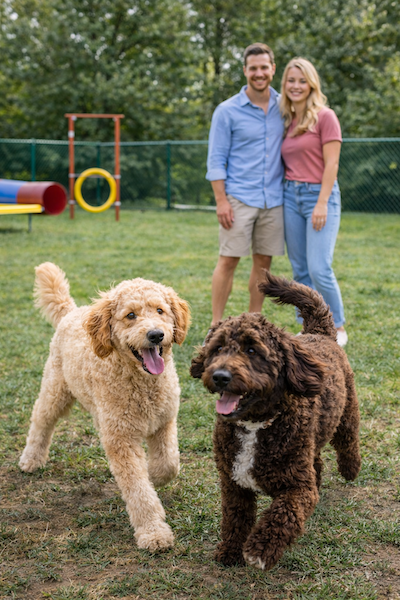
Goldendoodle and Labradoodle Grooming Guide: The Truth About Doodle Coats
Goldendoodle and Labradoodle Grooming Guide: The Truth About Doodle Coats
We say this with genuine affection for the breed and the families who love them: Goldendoodles and Labradoodles are among the most challenging dogs to groom well, and among the most commonly seen in a mat-emergency state. The marketing around doodles as low-shedding, low-maintenance dogs has led generations of owners into a situation they weren't prepared for — and their dogs have paid the price, often with a shave-down that devastated the owner's vision of what their dog was supposed to look like.
This guide is the honest version. It won't tell you what you want to hear about doodle coats. It will tell you what you need to know to actually keep your doodle's coat healthy and beautiful.
Why Doodle Coats Are So Unpredictable
Goldendoodles (Golden Retriever × Poodle) and Labradoodles (Labrador Retriever × Poodle) were developed to produce dogs with low-shedding, allergy-friendly coats. The idea was that the Poodle's single-layered, continuously growing coat would dominate in crossbred offspring, producing dogs that shed minimally and don't trigger allergies as severely.
It doesn't always work that way.
Doodle coats are genetically unpredictable. The same litter can produce puppies with coats ranging from nearly-flat and Retriever-like to tightly curled and almost Poodle-like. Most doodles land somewhere in between, with a wavy to loosely curled coat that is neither a proper Retriever double coat nor a proper Poodle single coat. It is, functionally, its own category.
F1 doodles (first generation, 50/50 cross) tend toward the middle of the spectrum — wavy coats that shed moderately.
F1B doodles (backcross, 75% Poodle) tend toward curlier, lower-shedding coats.
Multi-generation doodles can fall anywhere on the spectrum depending on which traits expressed dominantly.
The wavy, in-between coat that most doodles have is, from a groomer's perspective, the most challenging possible combination. It grows continuously like a Poodle coat (requiring regular haircuts) but has the texture and body of a Retriever coat (which tangles more readily than a curly Poodle coat). When loose undercoat from the Retriever genetics mixes with the continuously growing Poodle-influenced outer coat, the two layers weave together into mats with alarming speed.
The Puppy Coat Trap
Many doodle owners describe a period around 8–14 months where the coat suddenly becomes dramatically harder to maintain — more prone to matting, seemingly overnight. This is real, and it's the puppy-to-adult coat transition.
Doodle puppies typically have a softer, looser, more manageable coat. As they mature, the adult coat comes in — denser, with a different texture — and the transition period is a prime window for severe matting. The mix of puppy coat and adult coat textures creates exactly the right conditions for rapid tangling.
Many owners who were managing just fine suddenly find themselves with a dog in serious mat trouble during this transition. The response should be: more frequent grooming appointments (potentially every 4 weeks instead of 6–8), daily brushing, and ideally a groomer who can guide you through the transition proactively.
How Often Do Doodles Need Professional Grooming?
This is where the rubber meets the road: every 6–8 weeks is the maximum interval for a doodle with a managed coat. Many doodles need 4–6 week appointments to stay ahead of matting.
To be direct about this: the 8–12 week schedule that works for a German Shepherd or Labrador does not work for a doodle. The coat grows too quickly and mats too readily. Owners who try to stretch appointments to save money almost always end up paying more in the long run — in extra dematting charges, or in the cost of a shave-down followed by a full regrowth.
The math: a 4–6 week appointment schedule costs more than an 8–12 week one, but it means your dog actually has the coat you want.
The Shave-Down: What It Is and How to Avoid It
A shave-down is what happens when a groomer receives a dog in severe matting — mats that are too tight, too widespread, or too close to the skin to be safely brushed out — and the only humane option is to clip the entire coat short to remove the matted fur.
Shave-downs happen to doodles constantly. Not because the owners don't care, but because they don't know. The marketing told them doodles were easy. They were brushing — they thought — but using the wrong tools or the wrong technique. The coat looked fine on the surface but was felted against the skin underneath.
How to avoid it:
1. Use the right tools (see below)
2. Brush to the skin, not just the surface
3. Follow the comb test — if a metal comb doesn't pass freely through a section, it's not actually tangle-free
4. Keep your grooming appointments at 4–6 week intervals
5. Book your dog's adult transition period at 4-week intervals around months 9–15
If your groomer ever calls during an appointment to say the coat is more matted than expected and they need to modify the cut, they are doing you and your dog a service. Don't be angry — be grateful for the honest communication, and use it as a reset point.
Brushing Tools and Technique for Doodle Coats
The right tools are essential for a doodle:
Slicker brush: Your primary tool. Must be a high-quality, fine-pin slicker — cheap slickers bend their pins and don't penetrate the coat.
Metal greyhound comb: Non-negotiable. This is your truth-teller. Every section you brush must pass the comb test.
Dematting comb or mat splitter: For catching small tangles early. Use gently and from the outside of the tangle inward.
Detangling spray: Use before brushing, particularly on drier coats.
What you don't need: A de-shedding tool (Furminator) is designed for dogs with traditional double coats and is not appropriate for Poodle-influenced coats. It can actually damage the coat texture.
Technique: Part the coat in sections and brush from the skin out. Lift sections of coat and work underneath, then the surface. The biggest mistake doodle owners make is "topcoat brushing" — running the slicker along the top of the coat where it looks tidy while a solid mat is developing against the skin beneath. After every section, run the comb through from root to tip. If it snags, you're not done.
Frequency: Every 1–2 days for most doodles, especially those with curlier or denser coats. For very curly coats, daily brushing is not excessive.
Popular Doodle Cuts
Teddy Bear Cut: The most requested doodle style — uniform length all over, round face, full but manageable. Typically 1–2 inches on the body. The most practical option for most pet doodle owners.
Puppy Cut: Similar to the teddy bear but slightly shorter, giving a puppy-like appearance regardless of age. Low maintenance between appointments.
Kennel Cut: A shorter, more practical trim — typically under an inch — that minimizes home brushing requirements. Common as a reset after matting or for owners who want the easiest possible maintenance.
Longer Styles: Some doodle owners prefer a longer, flowy look. This is absolutely achievable — but it requires more frequent appointments and more diligent home brushing. The longer the coat, the faster the matting.
What to Tell Your Doodle's Groomer
Be honest about your home maintenance routine. A groomer who knows you brush daily can plan for a different cut than one who knows the dog goes a week or two without brushing. This isn't judgment — it's practical information that affects what cut is going to actually work for your dog and your household.
Come in with:
- A photo of your preferred cut and length
- An honest report of your brushing frequency
- Whether your dog is in the puppy-to-adult transition
- Any skin issues, sensitive areas, or behavioral notes
- Whether there are any mats you've noticed (or areas where you've lost track of the brushing)
Are Doodles Really Hypoallergenic?
It's worth addressing this directly: no dog breed is truly hypoallergenic. Allergies to dogs are typically triggered by the protein Fel d 1 (in cats) and Can f 1 (in dogs), which is found in saliva and skin oils, not primarily in the fur itself. Doodles may shed less than purebred Retrievers, which means less airborne allergen on the shed fur — but they still produce skin dander and saliva proteins that cause reactions.
If allergies are your primary reason for choosing a doodle, have family members spend time with the specific puppy or dog before committing. Litter variation is significant, and one sibling may be much better tolerated by an allergic person than another.
Finding a Groomer Who Knows Doodles
Doodle grooming has become a specialty in its own right. The best doodle groomers understand the coat variability, can advise on cut styles that work with your dog's specific coat texture, and will give you honest maintenance guidance rather than telling you what you want to hear.
Search Dog Groomer Locator for groomers who specifically mention doodle experience or breeds like Goldendoodles, Labradoodles, or Bernedoodles in their listing. A groomer who regularly works with doodles will have strong opinions about brushing tools and coat transition management — these are good signs.
If your doodle has anxiety around grooming appointments, which is common especially in dogs who didn't get proper early exposure, Holistic Vet Directory can help you find a veterinarian who addresses anxiety holistically, which may include behavioral approaches and supplements before resorting to sedation.
At-a-Glance: Doodle Grooming Schedule
| Task | Frequency |
|---|---|
| Brushing | Every 1–2 days |
| Bath | Every 4–6 weeks |
| Professional groom | Every 4–8 weeks (closer to 4 for curlier or longer coats) |
| Nail trim | Every 3–4 weeks |
| Ear check and cleaning | Monthly |
| Coat transition monitoring | Months 8–15 — weekly check for matting |
Doodles are wonderful dogs — affectionate, smart, and genuinely fun to be around. Their coats can be beautiful. But that beauty requires work, and the owners who understand that from the start — who invest in the right tools, learn the right technique, and keep their grooming appointments — are the ones whose dogs actually look like the vision they had when they chose the breed.
About the Author
Dog Groomer Locator Editorial Team
Our editorial team researches grooming topics using verified business data and breed-care references. Content is drafted with AI assistance, fact-checked against published sources, and reviewed by publisher Kevin Collins.