Labrador Retriever Grooming: Why Labs Need More Grooming Than You Think
Labrador Retriever Grooming: Why Labs Need More Grooming Than You Think
Labradors are beloved for being low-maintenance dogs, and in the ways that matter most to daily life, they genuinely are. They don't need haircuts. They don't mat. They're happy to be bathed without too much drama. But the idea that a Lab needs almost no grooming is a myth that leads a lot of owners to be caught off guard by the sheer volume of fur that a Labrador can generate.
Labs have one of the densest, most efficiently shedding double coats in the dog world. That short coat doesn't just sit there — it cycles constantly, and twice a year during coat blows, it comes out in quantities that are almost comically large. A thorough deshedding session can remove enough fur to make a second, admittedly rougher-looking dog.
This guide covers what the Labrador coat actually is, how to manage it effectively at home, and what professional grooming does for a Lab that home care can't replicate.
The Labrador Coat: Deceptively Dense
Labrador Retrievers have a short, dense, straight double coat. The undercoat is thick and woolly and serves as insulation and water resistance — Labs were originally bred as water retrievers, and the coat reflects that. The outer coat is hard and relatively smooth, designed to repel water and shake dry quickly.
Don't be deceived by the shortness. Short does not mean sparse. A Lab's coat is, volume for volume, one of the densest double coats in existence. The hairs are short but packed tightly, and the undercoat sheds on a near-constant basis with major blows twice a year.
Yellow, chocolate, and black Labs all have the same coat type. Color has no bearing on shedding volume or coat texture. What does vary is that yellow Labs often have their fur show more prominently on dark surfaces and furniture, while black Lab fur is more visible on light-colored upholstery. Neither sheds more than the other.
The Shedding Reality
Labs shed year-round, with two peak periods — typically in spring as the heavy winter undercoat releases and in fall as the summer coat sheds out before winter regrowth. During these peak periods, a Lab can lose astonishing amounts of undercoat over a matter of weeks.
Year-round shedding for a Labrador is moderate to heavy. Even between blows, you'll find Lab fur on clothing, upholstery, and in corners where you sweep regularly. This is simply the reality of the breed. What varies significantly is how well-managed it is.
A Lab with a consistent brushing routine and regular professional deshedding treatments sheds perhaps 40–50% less visibly than an identical dog who receives no grooming attention. The fur is still being shed — it's just being collected proactively rather than distributed across your house.
At-Home Grooming: Tools and Technique
For a Labrador, you don't need many tools, but the ones you use need to be appropriate for a dense double coat.
What you'll need:
- A de-shedding tool (a Furminator or similar) — the primary tool for undercoat removal
- A rubber curry brush — excellent for Labs; the rubber nubs loosen dead hair and feel like a massage to most dogs
- A slicker brush — for a finishing pass on the outer coat
- A grooming glove — many Labs love these; they work well for maintenance brushing and bonding
Technique: Labs are generally easy to brush and most enjoy the physical contact of grooming sessions. Use the de-shedding tool with moderate pressure, working in the direction of coat growth from neck to tail. Don't press hard enough to scrape the skin — you're lifting out loose undercoat, not raking the skin.
For regular maintenance brushing, the rubber curry brush or grooming glove works well and keeps most Labs relaxed and cooperative. Save the de-shedding tool for more thorough weekly sessions.
Frequency: Brush 1–2 times per week for regular maintenance. During shed season, increase to daily if you can.
Bathing a Labrador
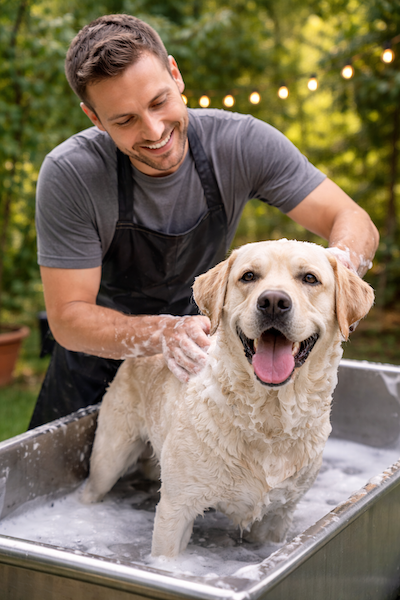
Labs are generally easy to bathe — they're large-bodied dogs who tolerate water well, and many actually enjoy it. What takes time is getting the coat thoroughly wet (the outer coat sheds water efficiently, so you need to really work shampoo through to the undercoat) and drying properly.
Bath frequency: Every 4–6 weeks is appropriate for most Labs. Dogs who swim regularly in lakes, rivers, or saltwater may need more frequent bathing to remove debris, algae, and salt from the coat. Dogs who swim in chlorinated pools should be rinsed after swimming to prevent coat dryness from chlorine exposure.
Before the bath: A quick brush-out first helps remove loose undercoat that would otherwise clog your drain and reduces the drying time afterward.
Shampoo: A standard dog shampoo formulated for normal to short coats works well. During shed season, an enzyme-based deshedding shampoo is worth using — it helps break down the bonds holding loose undercoat in place and can significantly increase how much fur comes out in the tub rather than in your living room over the following weeks.
Drying: This is the most underestimated part of bathing a Labrador. Labs shake efficiently and their outer coat dries quickly — but the undercoat doesn't. If you let a Lab go back inside to a crate or confined space with a wet undercoat, you're setting up conditions for skin irritation and potential hot spots. Towel dry aggressively, then let the dog finish air drying in a well-ventilated space, or use a dryer on low heat to speed the process.
Professional Grooming for Labs: What You're Actually Getting
The most valuable thing a professional groomer does for a Labrador is a proper deshedding treatment — particularly during spring and fall coat blows. A professional deshedding session typically includes a deshedding shampoo and conditioner applied to a fully saturated coat, a high-velocity blow-out that removes enormous quantities of loose undercoat while simultaneously drying the coat, and a thorough raking with undercoat removal tools post-dry.
The difference between a Lab before and after a professional deshedding treatment is significant. Most Labs leave with noticeably less coat volume — and more importantly, the loose fur that would have ended up on your furniture over the next several weeks has been removed in one contained session.
Professional grooming frequency for Labs: Every 8–12 weeks is reasonable for most pet Labs, with additional deshedding appointments during peak shed seasons. If cost is a consideration, a targeted deshedding treatment twice a year (spring and fall) combined with consistent home brushing the rest of the year is a practical and effective approach.
Ear Care for Labradors
Labradors have floppy pendant ears that limit airflow into the ear canal — and Labs love water, which means moisture in the ear canal is a recurring concern. Ear infections are among the most common health issues in Labs, and many are directly related to moisture and debris from swimming.
After every swimming session, dry your Lab's ears by gently inserting a cotton ball or ear drying product into the outer ear canal and allowing it to absorb moisture. Do not insert anything deeply into the canal.
Check ears weekly for redness, odor, dark waxy buildup, or discharge. If your Lab is showing signs of a recurring ear problem — frequent head shaking, pawing at ears, persistent odor — it's worth a veterinary evaluation. Labs who swim frequently are particularly prone to otitis externa, and sometimes what looks like a simple ear infection has an underlying allergic or environmental component worth investigating.
Paw and Nail Care
Labrador nails grow quickly, particularly in dogs who aren't walking on abrasive surfaces regularly. Overgrown nails affect a dog's posture and gait and can cause joint stress over time. Check nails monthly and trim when you can hear clicking on hard floors or when the nail visibly extends past the paw pad.
The fur between the paw pads can trap debris, burrs, ice melt, and moisture. Keep inter-digital fur trimmed short — this is a quick trim your groomer can handle at each appointment, or you can do it at home with blunt-tipped scissors and patience.
Hot Spots and Skin Health
Labradors are somewhat prone to hot spots (acute moist dermatitis) — red, weeping skin lesions that develop quickly, often triggered by moisture trapped under the coat. Hot spots can develop from a wet undercoat that doesn't dry completely, from allergic skin reactions, from insect bites, or from the dog licking and chewing at an irritated area.
The best prevention is regular grooming, thorough drying after baths and swimming, and keeping the coat free of debris and matted wet areas. If you notice a hot spot developing, have your veterinarian evaluate it promptly — they can become quite large and painful quickly. If your Lab has recurring skin issues or seasonal flare-ups, Holistic Vet Directory can help you find an integrative veterinarian who addresses skin health comprehensively, including dietary and environmental factors.
Finding a Groomer for Your Labrador
Most professional groomers are comfortable with Labradors — they're cooperative dogs without demanding coat requirements. What you want is a groomer who has a proper deshedding process rather than just a standard bath and brush. Ask specifically whether they offer deshedding treatments and what that service includes.
Dog Groomer Locator lets you search groomers by location and service type — look for listings that mention deshedding or double-coat grooming experience to ensure you're finding a groomer who can deliver the full benefit of a professional appointment for your Lab.
At-a-Glance: Labrador Retriever Grooming Schedule
| Task | Frequency |
|---|---|
| Brushing | 1–2x per week (daily during shed season) |
| Bath | Every 4–6 weeks |
| Professional deshedding treatment | Every 8–12 weeks (more during shed season) |
| Nail trim | Every 3–4 weeks |
| Ear check and drying | After every swim; weekly check |
| Paw pad fur trim | Monthly or as needed |
The Labrador is a wonderful breed — affectionate, enthusiastic, and genuinely easy to live with in most respects. The coat is the one area where they require more attention than their easy-going reputation implies. Get on a brushing schedule, invest in two professional deshedding treatments per year, and you'll find the shedding goes from overwhelming to manageable. The fur will still happen — but on your terms.
About the Author
Dog Groomer Locator Editorial Team
Our editorial team researches grooming topics using verified business data and breed-care references. Content is drafted with AI assistance, fact-checked against published sources, and reviewed by publisher Kevin Collins.