How to Groom a Matted Dog — And How to Prevent Mats From Coming Back
How to Groom a Matted Dog — And How to Prevent Mats From Coming Back
Mats are one of the most common problems at the grooming table, and they're also one of the most misunderstood. Many owners assume a mat is just a tangle — something to work through with a brush and some patience. But a true mat is a compressed mass of dead hair, live hair, and sometimes debris that has been tightening against the skin for weeks or months. It can pull the skin constantly, restrict movement, hide wounds, harbor parasites, and in severe cases, cause the skin underneath to become necrotic.
That's not meant to scare you. It's meant to reset the frame. Mats aren't just a grooming inconvenience — they're a welfare issue, and understanding them that way changes how you approach prevention and treatment.
What Actually Causes Mats
Mats form when shed hair (the dead coat that should fall out) gets tangled in the living coat instead of releasing. On a short-coated breed, shed hair just falls away. On a long or curly coat, it gets trapped and wraps around itself and other hairs, twisting tighter over time.
Certain things accelerate matting:
Friction. The most mat-prone spots on any dog are high-friction areas: armpits, behind the ears, under a collar or harness, between the back legs, and around the base of the tail. Anywhere the coat rubs against itself or against equipment, tangles form faster.
Wetness without brushing. When a long-coated dog gets wet and the coat is allowed to dry without being combed through, the coat dries in whatever position it was tangled in. This is how a walk in the rain turns into a grooming crisis. The matting doesn't happen from the water itself — it happens from not brushing afterward.
Infrequent grooming. The longer the interval between brushings, the more opportunity for tangles to progress to mats.
Coat type. Curly and wavy coats (Doodles, Poodles, Bichons, Cocker Spaniels) mat faster and more severely than other coat types. Owners of these breeds need to be especially consistent about maintenance.
Undercoat blowout. Double-coated breeds like Golden Retrievers and Bernese Mountain Dogs go through seasonal coat blows where enormous amounts of undercoat release. Without brushing during this period, the shed undercoat packs against the skin and mats.
Assessing the Matting: What Can You Handle at Home?
Before reaching for your brush, assess what you're actually dealing with.
Surface tangles are loose, feel like fluffy knots, and can be separated with your fingers. These are manageable at home with the right tools and approach.
Moderate mats feel firmer, don't separate easily with fingers, and may cover an area a few centimeters across. With the right tools, a detangling spray, and patience, these can often be worked through at home — but go slowly, and stop if your dog is showing significant distress.
Severe mats are dense, flat against the skin, cover large areas, or have been there long enough that you can feel them as a solid mass rather than a bundle of hair. These should not be attempted at home. They require professional dematting or clipping, and attempting to brush them out causes real pain — the mat is essentially attached to the skin, and every brush stroke pulls.
Pelted coat — where the entire coat has compressed into something resembling felt — is the most severe presentation. There is no brushing a pelted coat. The only option is clipping very close to the skin, which requires professional skill and the right equipment to do safely (the skin under a pelt is often sensitive, irritated, or may have wounds).
When in doubt, call a professional groomer. A good groomer will give you an honest assessment of what's needed and what it will cost before starting any work.
Tools for Home Dematting
If you're working on surface or moderate mats at home, the right tools make all the difference:
Dematting spray or detangling conditioner: Lightly mist the mat before working it. This lubricates the hair shaft, reducing friction and making separation easier. Don't saturate the coat — just enough to dampen the mat.
A dematting comb or mat rake: These have sharp, spaced teeth designed to cut through mats rather than pull. They're more effective on large mats than a standard slicker brush and cause less pain because they're cutting the mat rather than dragging it.
A metal greyhound comb: Use this to finish after breaking up a mat with the dematting comb. If it passes through the area without snagging, the mat is gone.
Blunt-tipped scissors or a seam ripper: For very localized mats, you can sometimes cut the mat lengthwise (parallel to the skin, not perpendicular) to break it into smaller sections. Be extremely cautious — never put scissors blade-to-skin, and never cut when you can't clearly see where the skin is. Mat splitters (a specialized blade tool) do this more safely.
The Right Way to Work Out a Mat
Never start at the root. This is the most common mistake, and it causes the most pain.
Hold the base of the mat between your thumb and forefinger, close to the skin, so you're acting as a buffer against the pull. Then work from the outside of the mat inward — teasing apart the outermost layer of hair first, then working progressively deeper. Think of it like unraveling a knot in a necklace: you work from the outside, loosening the outer loops before trying to open the center.
For stubborn spots, apply a little more detangling spray, then try separating with your fingers before using the comb. Sometimes a mat that won't move under a tool will start to release when warmed slightly by your hands.
Work in short sessions. If your dog is becoming stressed, stop. A distressed dog moves, and movement while you're working around the skin with any kind of tool creates risk. Dematting is also uncomfortable even when done skillfully — it's not a neutral experience, and you should take it at the dog's pace.
When the Answer Is to Clip
Sometimes the kindest thing you can do for a matted dog is cut the coat short and start over. That's disappointing for owners who love the look of a full coat, but a dog in significant matting discomfort is not a dog who is benefiting from that coat.
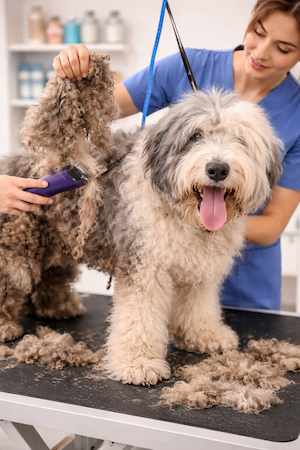
Clipping a matted dog requires skill. The clipper blade has to navigate between the pelt and the skin, which is closer than you might expect. Groomers who do this work carefully because nicking the skin on a matted dog is easy and the skin is already potentially irritated. It is not a job for a cheap set of clippers and a YouTube tutorial.
After a close clip, some dogs' skin is red and sensitive for a few days — this is normal after a pelt removal and doesn't necessarily indicate injury. It's also an opportunity to identify any sores, rashes, or parasites that were hidden under the mat. If you see anything concerning under a removed mat, have your vet take a look. For dogs with recurring skin conditions or a coat that takes repeated damage, working with a vet who considers nutrition and immune health alongside conventional care can help; Holistic Vet Directory can help you find one.
How to Prevent Mats From Coming Back
This is where most guides stop at "brush your dog regularly" and leave it there. Let's be more specific.
Know your dog's mat-prone spots and check them first, every time. Armpits. Behind the ears. The collar line. Between the back legs. The base of the tail. These are the places mats start. Running a comb through these areas every few days catches tangles before they become mats.
Brush before bathing, not after. This is counterintuitive but important. Wet hair expands, and a loose tangle becomes a tight mat when wet. Get the coat tangle-free before the bath, then again after drying.
Dry thoroughly and brush while drying. Using a dryer while running a brush through the coat keeps it from drying in a tangled position. If you can't do this at home, your groomer can do it during a bath-only appointment.
Reconsider the harness. If your dog's worst matting is always along the rib line and chest, the harness is contributing. Use a harness with minimal surface contact, check the fit regularly, and take it off when you're not walking to give the coat a chance to reset.
Keep appointments on schedule. If your dog's coat needs professional grooming every six weeks and you're going every ten, the difference adds up quickly. The longer the interval, the worse the coat condition at each appointment and the more ground the groomer has to cover. Staying on schedule is often cheaper per appointment and definitely kinder to your dog.
Consider a shorter pet trim. If you're struggling to stay on top of a long coat and your dog keeps arriving matted, talk to your groomer about a shorter maintenance trim. A shorter coat still looks beautiful on most breeds and is far easier to keep mat-free. The goal is a dog who's comfortable, not a dog who looks impressive in photos but is uncomfortable most of the time.
For finding a groomer near you who is experienced with dematting, coat type management, and setting up a realistic maintenance schedule, Dog Groomer Locator is a good starting point — look for groomers who list experience with your breed and read their service descriptions carefully.
What to Tell Your Groomer About Matting
Be honest. It can feel embarrassing to arrive with a matted dog, but please don't try to hide it or downplay it. A groomer who knows what they're walking into can plan the appointment properly, set appropriate expectations with you, and handle the dog with the care the situation requires.
Tell your groomer:
- Where you've noticed matting and how long it's been there
- What you've tried at home and how the dog responded
- Any areas where the dog is particularly sensitive
- Whether the dog has had reactions to previous dematting (fear, pain response, aggression)
A good groomer will check the coat condition before starting any work, give you an honest assessment of what's needed, and call you if they discover something unexpected — more severe matting than the surface suggested, a skin issue under a mat, or anything that changes the scope or cost of the appointment.
Mats happen to the most attentive owners sometimes — life gets busy, the dog swims more than expected, the schedule slips. What matters is addressing them promptly, doing it humanely, and then setting up a system that prevents it from becoming a recurring problem. Your dog will be more comfortable, your grooming appointments will go more smoothly, and honestly, the coat will be more beautiful for the consistent care.
If you're looking for a groomer with the skill and patience to handle a difficult coat situation, use Dog Groomer Locator to find professionals with experience in dematting and coat rehabilitation in your area.
About the Author
Dog Groomer Locator Editorial Team
Our editorial team researches grooming topics using verified business data and breed-care references. Content is drafted with AI assistance, fact-checked against published sources, and reviewed by publisher Kevin Collins.