German Shepherd Grooming Guide: Managing the Double Coat
German Shepherd Grooming Guide: Managing the Double Coat
German Shepherd owners talk about shedding the way other dog owners talk about bad weather — constantly, with a kind of resigned acceptance that it's simply part of life now. And they're not wrong. German Shepherds are formidable shedders, ranking comfortably in the top tier of year-round shedding breeds. During twice-yearly coat blows in spring and fall, the volume is something you genuinely have to see to believe.
But here's the good news for GSD owners: the shedding is manageable. Not eliminable, but manageable. The owners who struggle the most with German Shepherd fur are invariably the ones who don't have a consistent brushing routine, who skip grooming appointments, and who — when the shedding gets bad — try to solve it by shaving. This guide will walk you through the right approach to all of it.
Understanding the German Shepherd's Coat
German Shepherds have a medium-length double coat — a thick, dense undercoat and a harsher, straighter outer coat. The two work in concert: the outer coat provides weather resistance and some dirt repellency, while the undercoat provides thermal insulation. It's a working dog coat, designed for durability and protection across a wide range of outdoor conditions.
There is also a long-coated variety of German Shepherd — dogs with a noticeably longer, softer outer coat and fuller feathering on the ears, chest, belly, and legs. Long-coated GSDs shed as prolifically as their medium-coated counterparts but require somewhat more attention to the longer feathering areas that can tangle.
Coat color doesn't affect grooming needs. The classic black and tan, the sable, the all-black, the white, the blue — they all shed, and they all need the same essential care.
How Often Do German Shepherds Need Grooming?
At home: Brush at least 2–3 times per week. During seasonal shedding, daily brushing will meaningfully reduce the amount of fur that ends up on everything else.
Professional grooming: Every 8–12 weeks for most pet GSDs, with a targeted deshedding treatment during spring and fall coat blows. Some owners do professional deshedding treatments 2–3 times per year and handle maintenance brushing themselves between appointments.
German Shepherds don't require haircuts the way a Poodle or Shih Tzu does. Professional grooming is primarily about deep deshedding, bathing, nail care, and a thorough ear check. The coat doesn't need trimming beyond minor tidying around the paw pads and sanitary areas.
Brushing Tools and Technique
With a German Shepherd, having the right tools is particularly important because the undercoat is so dense.
What you'll need:
- An undercoat rake — your primary deshedding tool; reaches past the outer coat to pull loose undercoat
- A de-shedding tool (like a Furminator) — excellent for heavy shed season; use with moderate pressure, not aggressively
- A slicker brush — for finishing and smoothing the outer coat
- A wide-tooth metal comb — for checking work and catching remaining tangles
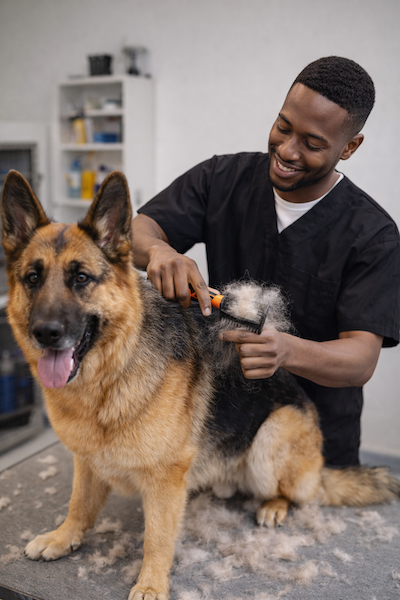
Technique: Work in sections from the neck backward, brushing in the direction of coat growth. Lift the outer coat to reach the undercoat beneath. Don't press so hard with deshedding tools that you're scraping the skin — a common mistake that can cause brush burn (a reddened, irritated area from repeated friction).
GSDs have particularly dense coat on the ruff (the mane-like fur around the neck and shoulders) and on the hindquarters and "pants" area. These areas accumulate more loose undercoat and deserve extra attention.
Long-coated GSDs should also be checked for light tangles in the feathering, particularly behind the ears and in the leg fringe.
Bathing a German Shepherd
Most German Shepherds need a bath every 6–8 weeks, though outdoor dogs who spend significant time in mud, water, or rough terrain may need more frequent bathing. Like all double-coated breeds, GSDs take longer to dry than they look like they should — the undercoat holds moisture for hours.
Before the bath: Thorough brush-out to remove as much loose undercoat as possible before getting wet. This makes the bathing and drying process significantly easier and more effective.
Shampoo selection: A high-quality dog shampoo designed for double coats works well. Deshedding shampoos that use enzymes to loosen undercoat during the bath are genuinely effective and worth using during shed season. Avoid over-stripping shampoos that remove the natural oils from the outer coat.
Drying: High-velocity dryers are transformative for double-coated breeds — they blast water out of the undercoat and simultaneously loosen enormous amounts of remaining loose fur. If you're drying at home without a high-velocity dryer, towel aggressively first, then use a standard dryer on cool or low-heat. Check that the undercoat is fully dry, not just the surface of the outer coat, before considering the bath finished.
Deshedding Treatments: What They Are and When to Use Them
A professional deshedding treatment is not just a bath and brush. Done properly, it involves a deshedding shampoo and conditioner, a full blow-out with a high-velocity dryer, and a thorough undercoat raking after the coat is completely dry. A good deshedding treatment can remove a genuinely remarkable volume of undercoat in a single session — sometimes enough fur to fill a grocery bag.
For German Shepherds, we recommend scheduling a professional deshedding treatment:
- Once during peak spring shed (typically March–May depending on your climate)
- Once during peak fall shed (typically September–November)
- As needed during the year if the shedding volume is getting ahead of your home brushing
These targeted treatments significantly reduce shedding for several weeks post-appointment and make home brushing much more manageable.
The Shaving Question — Don't Do It
Every summer, German Shepherd owners ask the shaving question. The impulse is understandable — it's hot, the dog is panting, and that coat looks like a liability. But shaving a German Shepherd is one of the most counterproductive things you can do for a healthy dog.
The GSD's double coat is a temperature management system, not just insulation. The undercoat traps a layer of air near the skin that helps regulate body temperature in both directions. When you shave the coat down, you eliminate that system and expose the skin directly to radiant heat from the sun. You may also disrupt the coat's normal regrowth, a phenomenon called post-clipping alopecia where the outer guard coat doesn't grow back correctly — sometimes permanently, sometimes partially, and often with a texture change that makes future matting more likely.
There is one exception: medical shaving. If a veterinarian needs to shave an area for a procedure or to treat a skin condition, that's appropriate medical care. Elective summer shaving is not.
If your GSD struggles with heat, focus on regular deshedding to remove the dead undercoat that actually does trap heat, provide shade and fresh water, and limit high-intensity outdoor activity during the hottest parts of the day.
Ear Care and Skin Checks
German Shepherds have upright ears that offer better airflow than pendant-eared breeds, which reduces but doesn't eliminate ear infection risk. Check ears monthly for redness, odor, waxy buildup, or dark discharge.
GSDs are also prone to skin issues — degenerative myelopathy aside, many German Shepherds have sensitive skin and can develop hot spots, contact dermatitis, or flea allergies that aren't always immediately visible under a thick coat. Regular brushing is one of the best ways to catch skin issues early, because you're handling the coat down to the skin and can feel or see any unusual areas before they become significant.
If your German Shepherd has recurring skin issues, hot spots, or apparent seasonal allergies that manifest in skin symptoms, it may be worth consulting a veterinarian who looks at environmental and dietary factors alongside conventional treatments. Holistic Vet Directory lists integrative and holistic veterinarians who take a comprehensive approach to chronic skin and allergy concerns.
Nail Care
German Shepherds are large, active dogs, and nails that are too long affect their gait and can cause foot and joint problems over time. If you can hear your dog's nails clicking on hard floors, they're overdue for a trim.
Active dogs who walk and run on pavement will naturally wear their nails somewhat, but most GSDs still need a trim every 3–4 weeks. Ask your groomer to include nails at every appointment.
What to Tell Your German Shepherd's Groomer
- Whether your dog is in active coat blow or between sheds
- Any skin issues, hot spots, or sensitive areas
- Whether the long coat or medium coat variety (if it's not obvious)
- Your preference on the paw pads — neatening the fur between and around the pads improves traction and reduces ice melt absorption in winter
- Any history of brush burns or tool sensitivity
At-a-Glance: German Shepherd Grooming Schedule
| Task | Frequency |
|---|---|
| Brushing | 2–3x per week (daily during shed season) |
| Bath | Every 6–8 weeks |
| Professional deshedding treatment | 2–3x per year (spring, fall, as needed) |
| Nail trim | Every 3–4 weeks |
| Ear check | Monthly |
| Paw pad hair trim | Monthly or as needed |
German Shepherds are not particularly difficult to groom — they don't need haircuts, they don't tangle dramatically, and they're generally cooperative on the grooming table once they trust their handler. What they need is consistency: regular brushing, proper deshedding treatments, and an owner who understands that the shedding will never completely stop but can absolutely be kept under control.
If you're looking for a groomer experienced with high-shed double-coated working breeds, use Dog Groomer Locator to filter for groomers who specifically mention deshedding services or double-coat experience.
About the Author
Dog Groomer Locator Editorial Team
Our editorial team researches grooming topics using verified business data and breed-care references. Content is drafted with AI assistance, fact-checked against published sources, and reviewed by publisher Kevin Collins.