Poodle Grooming Guide: Cuts, Maintenance, and What to Expect at the Salon
Poodle Grooming Guide: Cuts, Maintenance, and What to Expect at the Salon
If you've just brought home a Poodle — Toy, Miniature, or Standard — and someone hasn't yet warned you about the grooming commitment, consider this your official briefing. Poodles are singular dogs in many ways: extraordinarily intelligent, athletic, hypoallergenic-ish, and deeply loyal. They are also the most grooming-intensive breed most owners will ever own.
The good news is that Poodle grooming, when done on a proper schedule, is genuinely manageable. The coat doesn't shed in the traditional sense — loose hair gets caught in the curl rather than falling out — which means less fur on your furniture but more matting potential if brushing is neglected. The bad news is that "neglect" can happen faster than new Poodle owners expect. A week without brushing on a Toy Poodle can mean mats at the ear base that take a professional 30 extra minutes to resolve.
This guide will walk you through cut styles, maintenance realities, and what to look for in a groomer who actually knows Poodles.
The Poodle Coat: What You're Working With
Poodle coats are dense, curly, and single-layered — meaning there's no undercoat the way you'd find on a Labrador or Husky. Individual hair strands grow continuously (like human hair) rather than shedding on a cycle. The curl pattern means loose hairs entangle in the coat instead of falling away, which is the primary reason Poodles are considered low-allergen — but also why matting is such a constant consideration.
Puppy coats are typically softer and looser in curl than adult coats, and the transition — usually between 9 and 18 months — is a critical window for matting. The mix of puppy and adult hair textures during the transition period is particularly prone to tangling, and many owners are caught off guard by a sudden uptick in matting during this phase. This is one of the most important times to keep grooming appointments consistent and brushing daily.
Coat texture varies between individual dogs and lines. Some Poodles have tight, dense curls; others have a softer, wavier texture sometimes called "wavy Poodle." Texture affects how quickly the coat mats and which tools work best.
How Often Do Poodles Need Grooming?
This is the question new Poodle owners ask most, and the honest answer is: more often than they expected.
At home: Brush thoroughly every 1–2 days. No exceptions if you want to avoid matting.
Professional grooming: Every 4–6 weeks for most pet Poodles. This is not a flexible guideline the way 6–8 weeks might be for a Golden Retriever. At 8 weeks without a professional groom, many Poodles will have matting significant enough to affect the cut options. At 12 weeks, some require a complete shave-down.
If you're on a budget and trying to stretch appointments, the answer is more home brushing — not longer intervals between grooms. A Poodle left for 10 weeks with irregular home brushing is not a dog your groomer can simply "refresh."
Popular Poodle Cuts: A Practical Guide
Poodle cuts have a rich tradition — the elaborate continental and English saddle clips of the show ring are genuinely beautiful pieces of work — but most pet owners are choosing between a handful of practical, stylish options. Here's what to know about each.
The Puppy Cut (or Teddy Bear Cut)
This is the most requested cut by a wide margin. The coat is trimmed to a uniform length all over — typically 1–2 inches — giving the dog a round, plush, puppy-like appearance. It's the most practical and maintenance-friendly option for most pet owners. "Puppy cut" and "teddy bear cut" are often used interchangeably, though some groomers distinguish a teddy bear cut by the rounded face scissoring.
Best for: Owners who want low-maintenance between appointments, dogs who are active and outdoors frequently.
The Lamb Cut
Similar to the puppy cut on the body but with longer, more full legs — a bit like a lamb's rounded limbs. The legs are scissored round and full while the body is kept shorter. It's elegant and distinctive without requiring the precision of a continental clip.
Best for: Owners who want a more polished look with manageable maintenance.
The Miami Cut (or Bikini Clip)
The body is clipped short, the legs are left full (often with a pompon at the ankle), the face is shaved close, and the tail has a pompon at the tip. This is a classic Poodle look — stylish, breed-appropriate, and surprisingly practical.
Best for: Owners who want a traditional Poodle silhouette without show-ring complexity.
The Continental Clip
The clip associated with show Poodles — shaved hindquarters with rosettes over the hips, full mane on the chest, pompons on the ankles and tail. It's a stunning cut. It's also significant work to maintain and requires a groomer who knows Poodle breed styling. For pet owners who love the look, it's absolutely achievable — just know it requires 4-week appointments and thorough home brushing.
Best for: Owners who want show-ring aesthetics and are committed to the maintenance schedule.
The Kennel Cut
A practical, close-cut all-over clip — shorter than the puppy cut, often done when a dog comes in significantly matted or for owners who want the absolute minimum maintenance coat. It's not glamorous, but it's comfortable for the dog and practical for busy households.
Best for: Owners who prioritize function over appearance, or as a reset after a matting situation.
What to Tell Your Poodle's Groomer
Poodle grooming is one of the most communication-intensive services because the cut style options are so varied. Don't walk into a salon and say "a Poodle cut, please" — your groomer will have to guess, and their guess may not match your vision.
Come in prepared with:
- The specific cut name (or a photo if you have one)
- Your preferred length for the body (ask for an approximate guard size or inch measurement)
- Your preference for the face: a shaved, rounded face or a fuller "teddy bear" face
- Whether you want pompons on the legs/tail or a more uniform look
- Any areas where your dog is sensitive or has had skin issues
- Whether your dog is in the puppy-to-adult coat transition (relevant for matting risk)
A photo is worth more than any description. Many Poodle owners keep a photo on their phone of their ideal cut and show it at every appointment.
Brushing at Home: Tools and Approach
For Poodles, the right tools make a significant difference:
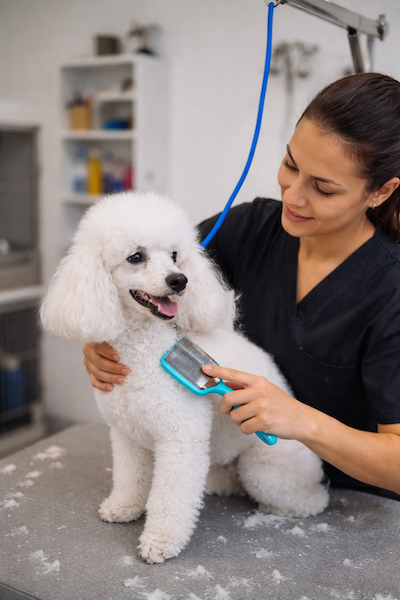
Slicker brush: Your primary tool. Use it to work through the curl in sections, brushing from the skin out rather than surface-brushing.
Metal greyhound comb: The comb test is definitive — if the comb passes through without catching, the section is clear. If it catches, there's a tangle the slicker hasn't fully resolved.
Detangling spray: A light mist before brushing reduces friction and breakage, particularly useful on dryer coats or in dry climates.
Mat splitter or mat rake: For small tangles before they become mats. Use these sparingly and gently — they're a first-response tool, not a solution for significant matting.
The technique matters as much as the tools. Work in sections, lift the coat and brush from the root out, and always follow with the comb. Behind the ears, under the collar, in the armpits, and around the rear end are the highest-friction areas where mats form fastest. These are also the areas most owners miss during casual brushing.
Dealing With Mats
Mats are a fact of life with Poodles if brushing slips. Here's the honest framework:
- Small, soft mats caught early: A slicker brush and detangling spray can often resolve these. Work gently from the outside of the mat in, never pulling directly through.
- Firm mats at the skin: These cannot be safely brushed out. Your groomer will need to work through them with tools and time — and most will add an additional dematting charge, which is fair and standard.
- Severe or widespread matting: A full or partial shave-down is the kindest option. Forcing tools through significant matting causes pain and skin damage. This isn't a failure — it's a reset point.
Never try to cut out a mat with scissors at home. The mat pulls the skin up into a tent shape, and it's very easy to cut skin that you can't see clearly. Let a professional handle anything you can't resolve with a brush and comb.
Ear Care for Poodles
Poodle ears grow hair inside the ear canal — a breed characteristic that requires specific maintenance. This hair can trap moisture and debris, contributing to ear infections if not managed. Some groomers routinely remove this hair; others prefer to leave it unless there's a specific concern.
We recommend discussing this with both your groomer and your veterinarian. Dogs prone to ear infections may benefit from regular ear hair removal; dogs without ear problems may do fine leaving it in place. There's genuine disagreement among groomers and vets on this, which is why a conversation is better than a blanket policy.
Check your Poodle's ears weekly for redness, unusual odor, discharge, or excessive head shaking. These are early signs of an ear infection. If your dog seems to be dealing with chronic ear issues, a veterinarian who takes an integrative approach to recurring conditions can be worth consulting — Holistic Vet Directory lists integrative and holistic vets who consider the whole picture, including recurring infections that might have dietary or environmental components.
Finding a Groomer Who Knows Poodles
Not all groomers have deep Poodle experience, and for this breed it matters more than most. You want someone who can execute breed-standard cuts if that's your preference, who understands the coat transition, and who can talk intelligently about matting prevention and management.
Ask directly: "How many Poodles do you groom per week?" and "What cuts are you most comfortable doing on Poodles?" A groomer who specializes in Poodles will light up at these questions. Browse Dog Groomer Locator to find groomers who list Poodle experience or breed-specific styling as a specialty — it's a much better starting point than a generic search.
At-a-Glance: Poodle Grooming Schedule
| Task | Frequency |
|---|---|
| Brushing | Every 1–2 days |
| Bath | Every 3–4 weeks |
| Professional groom | Every 4–6 weeks |
| Nail trim | Every 3–4 weeks |
| Ear check and hair removal | Monthly (discuss with vet/groomer) |
| Teeth brushing | 2–3x per week |
Poodles reward the investment in their grooming. When the coat is properly maintained, they're genuinely striking dogs — the cut creates silhouette and personality in a way no other breed's grooming quite does. The owners who fall in love with Poodle grooming tend to enjoy the artistry of it. And even owners who just want a tidy, comfortable pet will find that a consistent 4–6 week schedule with regular home brushing makes the whole thing far less daunting than it looks from the outside.
About the Author
Dog Groomer Locator Editorial Team
Our editorial team researches grooming topics using verified business data and breed-care references. Content is drafted with AI assistance, fact-checked against published sources, and reviewed by publisher Kevin Collins.