How to Choose a Dog Groomer Near You (And What to Look For)
How to Choose a Dog Groomer Near You (And What to Look For)
By Sarah Mitchell, Certified Master Groomer (CMG), International Professional Groomers Inc.
Finding the right dog groomer is one of the most important decisions you'll make as a pet owner — and one that doesn't get nearly enough attention. Most people pick a groomer based on proximity or price, book an appointment, and hope for the best. But a grooming appointment isn't just a haircut. It's a health checkup, a trust exercise, and for anxious dogs, a potentially defining experience. Choosing the wrong groomer can mean a dog that trembles at the sight of a carrier for years to come. Choosing the right one means a dog who trots happily through the salon door.
I've been a certified master groomer for 15 years. I've worked in salons, run my own mobile operation, and groomed dogs ranging from two-pound teacup Chihuahuas to 180-pound Great Pyrenees. What I've learned is that a good groomer and a mediocre one often look the same from the outside — same scissors, same prices, same smiling reviews. This guide will help you look past the surface and find a groomer who's genuinely right for your dog.
Start With a Search, But Don't Stop There
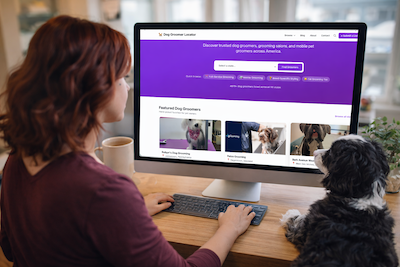
When you type "dog groomer near me" into Google, you'll get a list. That list is your starting point, not your answer. Use a directory like Dog Groomer Locator to browse groomers by location, read real service listings, and filter by specialty — mobile grooming, breed-specific styling, puppy first grooms, or senior dog services. Directories give you structured information that Google's map pack can't: service categories, pricing transparency, and hours.
Once you have a shortlist of three or four candidates nearby, the real evaluation begins.
Credentials Matter — Here's What to Look For
Not every state licenses dog groomers, which means technically anyone can call themselves one. That makes credentials the single most useful filter for separating professionals from weekend enthusiasts.
The gold standard is the Certified Master Groomer (CMG) designation from the International Professional Groomers or the National Certified Master Groomer (NCMG) from the National Dog Groomers Association of America. These require written exams, hands-on testing across multiple breed groups, and continuing education. A groomer who holds either of these has been evaluated by peers, not just approved by themselves.
One step below — but still significant — are certifications from the National Dog Groomers Association of America (NDGAA) or completion of a recognized grooming school program. Many excellent groomers have these credentials and years of practical experience but haven't sat for master-level exams yet.
What you don't want: a groomer who can't name any credential when asked, or who cites only a short weekend course.
Ask directly: "What grooming certifications or training do you hold?" A professional will answer this without hesitation and with pride.
Visit Before You Book
A reputable groomer will allow you to see the salon before your dog's first appointment. If they refuse or seem put off by the request, that's information. Here's what to look for during your visit:
Cleanliness
The facility should smell clean, not just deodorized. Wet dog smell is normal. Ammonia, feces, or a heavy chemical cover-up smell is not. Look at the floors, the tubs, and the equipment. Hair accumulation on tools is normal between cuts — a grooming table that hasn't been wiped between dogs is not.
Crate and kennel setup
Are dogs crated with appropriate spacing? Is there fresh water available? Are crates sized for the animal inside? A Great Dane shouldn't be crammed into a medium kennel because it was the only one open.
Temperature
Dryers blow hot air. The facility should be ventilated. Dogs left under hooded dryers without supervision can overheat quickly — this is one of the most common causes of grooming-related fatalities. Ask how drying is managed and whether dogs are ever left unattended under heat.
Number of dogs vs. staff
If you walk in and see twelve dogs and one person, ask how appointments are staggered. A well-run salon limits how many dogs are in-house at once. An overloaded shop means rushed work and dogs sitting in crates longer than necessary.
Ask About Their Experience With Your Breed
Dog grooming is not a one-size-fits-all skill. Grooming a Poodle and grooming a Siberian Husky require fundamentally different knowledge — different coat types, different tools, different techniques, and for some breeds, different philosophies about what should and shouldn't be trimmed.
Double-coated breeds like Huskies, Goldens, and German Shepherds are particularly easy to mishandle. Shaving a double coat doesn't help a dog stay cooler in summer — it can actually impair thermoregulation and damage coat regrowth. A groomer who suggests shaving your Husky "for the heat" without flagging these risks either doesn't know better or doesn't care.
For breeds with specific AKC or breed club cut standards — Poodles, Schnauzers, Cocker Spaniels, Bichons — ask if the groomer is familiar with breed-standard cuts versus pet trims. You don't need a show cut for a pet, but you want someone who at least knows the difference.
How to Find a Dog Groomer Who Handles Anxiety
Grooming anxiety is more common than most owners realize. The noise of dryers, the restraint of the table, the unfamiliar smells, the handling of sensitive areas like ears and paws — it adds up fast, especially for dogs who weren't properly introduced to grooming as puppies.
Before you book with a new groomer, describe your dog's specific triggers. A good groomer will ask clarifying questions and suggest accommodations. A great one will propose a desensitization approach — a shorter first visit, table time without grooming to build comfort, or a technique-first/tool-second method for sensitive dogs.
Red flags: a groomer who says "they'll get used to it" or who recommends sedation as a first resort. Sedation has its place for truly medically unmanageable dogs, but it should never be the default for a nervous dog. It should also always be done in consultation with your veterinarian — if you're dealing with a dog whose anxiety affects both grooming and vet visits, a holistic or integrative approach may help; Holistic Vet Directory can help you find a vet who addresses behavioral and anxiety issues alongside physical health.
Read Reviews the Right Way
Online reviews are useful, but only if you read them critically. Here's how to get signal from the noise:
Look at the 3-star reviews. Five-star reviews are often from people who haven't experienced a problem. One-star reviews are often from people who are furious about one specific incident. Three-star reviews tend to be the most balanced and specific: "The cut was fine but my dog was there for five hours." "They're good with small dogs but seemed overwhelmed when I brought my Standard Poodle."
Filter for mentions of your dog's breed or coat type. If you have a Doodle and the reviews are all about Yorkies and Maltese, that's relevant information.
Watch for patterns. One review mentioning a long wait is an outlier. Four reviews mentioning long waits over the past six months is a pattern.
Look at how the business responds to negative reviews. A professional groomer who responds calmly, takes responsibility, and offers to make things right is demonstrating exactly the temperament you want near your dog.
Price: What's Fair and What's a Red Flag
Grooming prices vary widely by region, breed, coat condition, and salon type. In most U.S. cities, a full-service groom for a medium-sized dog runs $60–$100. Mobile grooming adds $20–$50 for the convenience and one-on-one attention. Large or heavily coated breeds often cost more, as they require significantly more time.
Be wary of prices that are dramatically below market rate. Grooming requires professional tools, professional-grade shampoos and conditioners, appropriate facility maintenance, and trained staff. A salon charging $25 for a full groom is either cutting corners somewhere or losing money — neither of which is good for your dog.
Ask about what's included in the base price. Some salons include nail grinding, ear cleaning, and teeth brushing in a standard package. Others charge à la carte. Know what you're getting before you drop off.
Also ask about upcharge policies. Many groomers charge additional fees for matted coats — this is legitimate and standard practice, because dematting takes time and is uncomfortable for the dog. What you don't want is surprise charges added after the fact without discussion. A good groomer will call you if they discover coat condition that changes the pricing before they proceed.
Your First Appointment: What to Watch For
Your dog's body language when you pick them up tells you a great deal. A dog who's tired but calm, who greets the groomer with a tail wag, who seems content — that's the goal. A dog who is visibly shaking, who has stress lines around the eyes, who is desperate to leave, or who has unexplained scratches or injuries is telling you something went wrong.
Ask the groomer how your dog did. A good groomer will give you a genuine report: "He was nervous on the table at first but settled down after I showed him the clippers before starting." "She was perfect — one of the easiest dogs I've had all week." These kinds of reports are a sign you're working with someone who pays attention to the individual animal.
Making Your Choice
The right groomer is one who has verified training, a clean and safe facility, experience with your breed's specific needs, transparent pricing, and — most importantly — a genuine interest in making your dog comfortable. Don't settle for convenience alone.
Use Dog Groomer Locator to search groomers in your area, compare services side by side, and find professionals with the credentials and specialties that match your dog's needs. Read the listings carefully, check the review sources linked, and do the quick phone or in-person consultation before committing. Your dog can't tell you what happened in that salon. It's worth the extra hour of research to make sure it's somewhere you'd be comfortable leaving them.
Sarah Mitchell is a Certified Master Groomer with over 15 years of experience working with all breeds. She specializes in breed-specific styling and writes about coat health, grooming technique, and helping owners find the right professional care for their dogs.
About the Author
Sarah Mitchell
Certified Master Groomer (CMG), International Professional Groomers Inc.
Sarah Mitchell is a Certified Master Groomer with over 15 years of experience in professional pet grooming. She has worked with all breeds from toy poodles to giant schnauzers and specializes in breed-specific styling and coat health. Sarah writes about grooming techniques, coat care, and choosing the right groomer for your dog.